DMS Posts

Company cars What’s new for 2018/19?

Despite year-on-year tax rises, company cars remain a popular benefit. While the tax cost of expensive high-emission cars can be eye-watering, by choosing carefully it’s possible to enjoy the convenience that comes with a company car for a relatively low tax cost. So, as the new tax year gathers steam, what’s changed for 2018/19?

The tax charge
Company cars are taxed as a percentage of the list price, which is essentially the  manufacturer’s valuation of the car when new. It doesn’t matter how much was actually paid for the car, or whether it was bought second-hand.
It’s the list price that is used to work out the taxable amount and,
where optional accessories are added, the list price is adjusted to
reflect these.
The percentage charged to tax (the appropriate percentage) depends on the level of the car’s carbon dioxide (CO2) emissions. This increases each year, and 2018/19 is no exception. For 2018/19, the appropriate percentage for a car with CO2 emissions of 50g/km or less is 13% (up from 9% for 2017/18), whereas for cars with CO2 emissions in the range of 51 to 75g/km it is 16% – up from 13% – for 2018/19.

For cars with CO2 emissions of more than 76g/km, the charge for 2018/19 is two percentage points higher than in 2017/18 at 19% for cars in the 76 to 94g/km band.
This increases thereafter by 1% for each 5g/km rise in CO2 emission, although there is a maximum charge of 37% which applies to cars with CO2 emissions of more than 180g/km in 2018/19.

The increase in the appropriate percentage means a company car driver will pay more tax on the same company car in 2018/19. When calculating the charge, the list price is reduced for any capital contributions made by the employee (capped at £5,000), while the benefit is reduced to reflect any payments for the private use of the car. If the car is unavailable for part of the tax year, the benefit is proportionately reduced.

Example 1
Tony has a company car worth £30,000 with CO2 emissions of 150g/km, which was available throughout 2017/18. He isn’t due to change his car until July 2019 and pays tax at 40%.
For 2017/18, the appropriate percentage is 29% and the cash equivalent value of the car, on which Tony is taxed, is £8,700. As a higher rate taxpayer, the associated tax bill is £3,480 (£8,700 @ 40%).
For 2018/19, the appropriate percentage has increased to 31%. The taxable amount rises to £9,300 (31% of £30,000) and the associated tax to £3,720 (40% of £9,300).
Although he has the same car, even if it is a year older, Tony pays £240 more in tax as a result of the increase in the appropriate percentage.


Diesel cars
Diesel cars attract a supplement but the nature of that supplement has changed for 2018/19 and beyond.
For 2017/18 and earlier tax years, the supplement was 3%. This increased the appropriate percentage by 3%, compared to that for a petrol car with the same emissions level.

The diesel supplement cannot take the charge above the maximum of 37%. For 2018/19, the diesel supplement increased from 3% to 4% for all cars that aren’t certified to the Real Driving Emissions 2 (RDE2) standard.
The supplement applies to cars registered on or after 1 January 1998, which don’t have a registered nitrogen oxide (NOx) emissions value, and also to cars registered on or after that date which have a registered NOx emissions value that exceeds the RDE2 standard.
While the appropriate percentage is set by reference to CO2 emissions, the new-look diesel supplement is dependent on NOx emissions level.
Under the new rules, diesel cars certified to the RDE2 standard are not subject to the diesel supplement.
In practice, it is unlikely cars on the market before 6 April 2018 will meet the RDE2 standard, with the effect that most diesel cars will be subject to the higher supplement.
Taking into account the increases in appropriate percentages as well, diesel car drivers will suffer a higher tax hike in 2018/19.


Example 2
Maria has a diesel-fuelled company car with a list price of £30,000 and CO2 emissions of 150g/km. Her car doesn’t meet the RDE2 standard but it’s available throughout 2017/18 and 2018/19, and like Tony, Maria is a higher rate taxpayer.
In 2017/18, the appropriate percentage is 32% (normal 29% plus diesel supplement of  3%). This makes the taxable value £9,600 (32% of £30,000) and the tax owed is £3,840 (40% of £9,600).
In 2018/19, the appropriate percentage has increased to 31% and the diesel supplement to 4% – a total of 35%. As a result, the taxable value is £10,500 (35% of £30,000) and the tax bill is £4,200.
The combined effect of the rise in the appropriate percentage and the increase in the diesel supplement means Maria’s taxed £360 more in 2018/19 than in 2017/18 – £120 more than the tax rise suffered by Tony on his petrol car.

Going green
Drivers choosing lower-emission cars are rewarded with lower tax bills.
In the earlier example, Tony paid tax of £3,720 on his company car based on a CO2  emission of 150g/km.
If he had chosen a car of the same value but with CO2 emissions of 40g/km, he would’ve paid tax of £1,560 in 2018/19 (40% (£30,000 @ 13%)) – saving £2,160 a year and £180 a month.
Going electric
Electric cars with zero emissions are charged at the same percentage as cars with CO2 emissions of 50g/km and below – 13% for 2018/19.

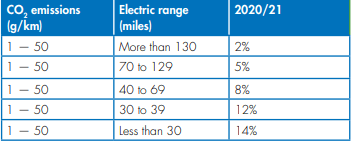
However, from 2020/21 new emission bands will apply to cars with CO2 emissions of 50g/km or less based on the electric range of the car.
This is the maximum distance the car can travel without recharging the battery or using the combustion engine of the plug-in vehicle.  Under the new bands, the cars with the greatest range have the lowest appropriate percentage.
The rates for the new bands, which will apply for 2020/21, are shown in the table below. The appropriate percentage is set at 2% for zero-emission cars.
electricpercent

It will pay to go electric, and the opportunity to benefit from a lower tax bill for an  electric car should be taken into account when choosing a new company car.

Fuel
A separate fuel scale charge applies where fuel is provided for private mileage in a company car.
This is found by applying the appropriate percentage (as used in working out the taxable benefit of the car) to a set amount. For 2018/19, this is £23,400 – up from £22,600 in 2017/18.
This means that for a car with CO2 emissions of 150g/km, the fuel charge is £7,006 for 2018/19, costing a higher rate taxpayer £2,802.40 in tax – or £233 a month.
Unless private mileage is very high, private fuel is rarely a tax-efficient benefit and where the cost of the car is below the appropriate amount (£23,400 for 2018/19), more tax will be payable on the fuel than on the car.
By contrast, no fuel charge arises if the employer provides electricity for an electric car.

Choosing wisely
The company car tax rules reward those who choose greener cars.
The tax charge on a cheaper, low-emission car is considerably less than an expensive car with high CO2 emissions.

Looking ahead, choosing an electric car will lower the bills still further with a taxable amount as low as 2% of the list price.

 

DMS Posts

MTD: CIOT webinar explains how it should work

Rebecca Cave listened to the CIOT webinar on MTD, which provided some useful insights on how HMRC will apply the MTD for VAT regulations, and where the other aspects of the MTD project have got to.

The webinar was presented by Richard Wild and Margaret Curran of the CIOT technical team, alongside Adrian Rudd of PwC, who chairs the CIOT digitalisation and agent strategy working group. The CIOT team has amassed a huge pool of knowledge about MTD as they have been in close contact with HMRC at all stages of this project.

The webinar covered these areas of MTD:

  • VAT
  • Income Tax pilots
  • MTD for individuals
  • Tax agents
  • Companies and complex businesses

I have picked out some key points to report, but I recommend listening to the entire 90-minute webinar, which can be streamed for free, and rerun multiple times so you can share it with your staff.

VAT notice

HMRC is expected to issue its definitive guidance on MTD for VAT in the form of a VAT notice, in the very near future. This notice will set out how a business will be able to claim an exemption from MTD filing on the grounds of religious believes, insolvency procedure or not reasonably practical. Once HMRC has accept the business is exempt from MTD for VAT reporting, it should also be exempt from income tax reporting for MTD.

Who is drawn into MTD?

All VAT registered businesses with UK taxable turnover over the VAT registration threshold (currently £85,000) will be required to comply with the MTD recording keeping and reporting requirements for the VAT periods which begin on and after 1 April 2019. VAT periods will not be split, so if the VAT period ends on 30 April, the business will enter the MTD regime from 1 May 2019.

Where a business is VAT registered but has turnover under £85,000 at April 2019, it is not required to enter the MTD regime in April 2019. However, those businesses will have to monitor their turnover on a rolling 12-month basis, and if the turnover breaches the VAT registration threshold, the business will have to enter the MTD regime from the beginning of the next VAT period.

Once a business is within the MTD regime, it can’t opt out even if its turnover drops below £85,000. The only way out of the MTD for VAT regime will be to deregister for VAT.

Any business which registers for VAT on or after 1 April 2019 will be required to enter the MTD regime from the start of their first VAT period, unless the business has registered voluntarily, in which case MTD reporting will not be mandatory.

Charities with trading subsidiaries, and landlords who let VAT-opted property, will fall within the MTD regime on the same terms as other businesses.

VAT returns under MTD

HMRC is committed to supporting parallel means for voluntarily registered businesses to submit VAT returns, ie by way of the current online interactive VAT form, but only until April 2020. It is possible that all VAT registered businesses will be mandated into MTD for VAT from April 2020.

All VAT returns for businesses which are mandated into MTD will have to be submitted via MTD-compatible software which uses an API to transmit data to HMRC.

What to record

As a tax agent you will be permitted to maintain the digital records required for MTD on behalf of your clients. The digital records for the quarter need to be completed by the earlier of:

  • The due date of the VAT return
  • The date on which the VAT return is actually submitted

All VAT records need to be retained for six years, but HMRC won’t require the digital records to be held in the accounting software in which they were recorded. That data can be downloaded and retained in some other form.

The webinar went into some detail about what exactly will have to be digitally recorded for each transaction, as the MTD rules are more onerous than the current rules for recording sales and purchases for VAT purposes.

Retail business and those using certain special schemes won’t have to digitally record every transaction. Those relaxations from the VAT regulations will be set out in the forthcoming VAT Notice on MTD.

How data will be transferred

The webinar contained several examples of how the VAT data may be transferred to HMRC from the software or spreadsheet where it was recorded. These examples will be contained in the VAT notice in a similar form.

From April 2019 the relevant totals for the VAT return plus any voluntary supplementary data must be submitted to HMRC via an API from the MTD-compatible software.

However, HMRC realises that businesses use combinations of software and spreadsheets, so data needs to be transferred between these different elements. For the first year of MTD, those transfers between software or spreadsheets need not be made digitally, but from 2020 such transfers must be done via a digital link.

Manual adjustments to the VAT data will be permitted to the VAT account, say for partial exemption calculations. There will be more information on this in the VAT notice.

Software availability

There is a timing issue for software production as we are only nine months away from the go live date. Currently there are very small numbers of businesses and software companies testing MTD-compatible software in the MTD for VAT trial.

Richard Wilde commented that its going be a “very tight timetable” to get MTD software ready on time. Once the software products are adequately tested, the detail of how to obtains those products will be listed on HMRC pages of gov.uk.

Adrian Rudd commented that PwC are building API-enabled spreadsheets and other MTD software. PwC has made an offer that the API-enabled spreadsheets will be available free of charge to charities to use.

Penalties

A new penalty points system for MTD will be introduced, and the draft legislation to enable this is expected to be issued this summer.

During the first 12 months of the MTD regime HMRC will not generally impose penalties for non-compliance, but this soft-landing approach will only apply to businesses who make a real effort to comply. Those businesses who make no attempt to meet the MTD requirements should expect penalties to be imposed.

Publicising MTD

HMRC’s attitude to non-compliant businesses seems a bit unfair as it has made very little effort to communicate the changes to the business community at large.

The CIOT have been urging HMRC to start telling businesses that MTD is coming in 2019. HMRC is apparently developing a communication plan, but the CIOT have not seen a draft.

Income tax reporting

As for MTD for VAT there will be a de-minimus turnover limit for MTD income tax reporting, below which MTD reporting will be voluntary. This threshold is expected to be £10,000 for income tax, but as HMRC hasn’t confirmed this figure, it could be set at a higher level in regulations.

However, we do know the threshold will be set per taxpayer not per business, as for VAT. For example, an individual with £6,000 rental income and £6,000 of trading income will fall within the MTD income tax regime, as his total turnover of £12,000 will exceed the expected £10,000 minimum threshold.

Adrian Rudd said the quarterly reporting of the raw trading results to HMRC for income tax will serve no purpose other than prove to HMRC that the business is keeping digital records.

The quarterly data won’t be adjusted for tax matters such as disallowable deductions, or for accounting adjustments such as accruals, as those adjustments will be made in the final report for the year. As such the MTD quarterly reports can’t be “wrong”, and the figures will not be enquired into.

Each business (not taxpayer) will have to do an MTD return for income tax, whereas for VAT the reporting it will be per VAT registration. The reporting deadlines for income tax and VAT will be different and separate, even if the VAT quarters align with the accounting period, as the VAT reporting period has an extra seven days.

It is possible that MTD for income tax will be mandated as early as April 2020, but the CIOT expect this implementation date to be later.

Companies and complex businesses

Partnerships will not be within MTD for income tax if their turnover is greater than £10 million.

HMRC appears to have no settled policy on MTD for corporation tax. CIOT has been told that will be a formal consultation on MTD for corporation tax “later in Spring 2018”. In theory MTD for corporation tax could be mandated as early as 2020, but that seems unlikely.


Written by: 

DMS Posts

Advisory fuel rates for company cars

New company car advisory fuel rates have been published which take effect from 1 June 2018. The guidance states: ‘You can use the previous rates for up to one month from the date the new rates apply’.

The rates only apply to employees using a company car.

The advisory fuel rates for journeys undertaken on or after 1 June 2018 are:

Engine size Petrol
1400cc or less 11p
1401cc – 2000cc 14p
Over 2000cc 22p
Engine size LPG
1400cc or less 7p
1401cc – 2000cc 9p
Over 2000cc 14p
Engine size Diesel
1600cc or less 10p
1601cc – 2000cc 11p
Over 2000cc 13p

The guidance states that the rates only apply when you either:

  • reimburse employees for business travel in their company cars
  • require employees to repay the cost of fuel used for private travel

You must not use these rates in any other circumstances.

If you would like to discuss your car policy, please contact us.

Internet link: GOV.UK AFR

DMS Posts

Entrepreneurs’ Relief is a capital gains tax relief available to those selling or giving away their business.

Entrepreneurs’ Relief reduced the amount of CGT paid on a disposal of qualifying business assets on or after 6 April 2008.

This relief will be available to:

Sole traders and partners selling or gifting the whole or part of their business
Company directors and employees holding at least 5% of ordinary shares and voting rights in a qualifying company who will share or gift all or part of their shareholding
In 2010, the relief changed to qualifying gains arising from 23 June 2010 being taxed at a flat rate of 10%, with the previous need to reduce the gain by 4/9ths being removed.

Conditions for relief

To claim relief, you have to satisfy a number of conditions through the qualifying period, which depend on the type of business disposal you’ve made.

Relief is available where there is either:

Material disposal of business assets
Disposal associated with a material disposal
Disposal of trust business assets
Disposal of a material asset

If the person is only selling part of a business, this part must be capable of being carried on as a going concern.

According to Tolley’s guidance, the disposal of assets which don’t constitute a sale of business capable of being carried on in its own right won’t qualify for the relief.

The definition of a material disposal depends on the type of asset sold:

In the case of a sale or gift of whole or part of a sole trade or partnership business, it must have been owned by the vendor throughout the year ending on the date of the disposal or cessation
It must have been owned by the taxpayer for one year prior to cessation and must be sold within three years of cessation
In the case of the sale or gift of shares or securities in a company, the disposal is material if throughout one year prior to the disposal of shares or date company ceased trading:

The company is a trading company
The company is the taxpayer’s personal company
The taxpayer is an officer or employee of the company or another company in the same group
Entrepreneurs’ Relief is only given in respect of relevant business assets, i.e. assets used for business purposes such as premises.

This means businesses can’t get relief for chargeable assets bought within the year, as long as they are brought into use in the business.

There is no relevant business assets requirement for the sale of shares or securities, meaning there is no need to prorate the relief in accordance with underlying investments held by the company.

Tolley advises using HMRC’s CGT for land and buildings toolkit when calculating the capital gain or loss on the disposal of land or buildings.

Definition of a trading company

According to Tolley Guidance, this is a company carrying on trading activities which does not include to a substantial extent activities other than trading activities.

HMRC says “substantial extent” means more than 20%. However, 20% of what?

Tolley says the test is applied to criteria such as:

Turnover
Asset base or balance sheet
Expenses
Directors’ time
CG64090

HMRC won’t apply the test if the company had a particularly poor trading period. Without this, according to Tolley, a company with seasonal trading fluctations, for example, might not be considered a trading company.

It’s suggested that the taxpayer might consider making a non-statutory business clearance application to HMRC for a trading status ruling, which would be separate to tax compliance from the shareholder.

Associated disposals

A disposal made after material disposal of business assets can qualify for Entrepreneurs’ Relief it it’s associated with it.

How it can be associated:

The individual makes a material disposal of the whole or part of their interest in a partnership or shares or securities in their personal trading company
The material disposal is made as part of the withdrawal of participation in the business
The asset sold after material disposal had been used in that business throughout one year ending with either the disposal or cessation of the partnership or company
Tolley said these conclusions flagged a few points, including:

The associated disposal rules don’t apply to sole traders
These rules don’t apply to isolated disposals of assets
The material disposal must happen first
HMRC says there should not be a significant interval between the material disposal and associated disposal.

Time-frames for associated disposal are:

Within one year of cessation
Within three years of cessation if the asset hasn’t been leased or used for any other purpose after the business ceased
Where the business hasn’t ceased, within there years of the material disposal provided the asset hasn’t been used for any purpose other than that of the business
There are also restrictions of relief on an associated disposal: If the asset is used in the business for only part of the ownership period, is only partly used in the business, or if the individual isn’t involved in the business throughout the period or if the asset was rented to the business.

How to claim and report Entrepreneurs’ Relief

It must be claimed by the first anniversary of the 31 January following the tax year of the disposal.

The gains are reported via usual channels on the CG summary supplementary pages in accordance with the type of asset sold. Calculations of the gains must be attached and submitted with the tax return.

The relief is claimed by crossing boxes 20, 26 and 34 based on the type of asset and including details in the white space on page CG2.


Entrepreneurs’ Relief

Written by: 

DMS Posts

How to make company car purchases cost effective

Tax and NI charges can make company cars expensive. However, if you use your business to run a car for a family member, say a son or daughter, there are steps you can take to make it cheaper than personal ownership. What are they?

Expensive but still cost effective

In April 2018 the tax and NI charges for company cars crept up again. While the maximum charge didn’t increase, the CO2emissions bands moved so that the majority of company car drivers will pay more in 2018/19 and in 2017/18 for the same car. Despite this, financing a car through your company can be more cost effective than doing it personally. This is something to keep in mind if your spouse, son or daughter needs a new set of wheels.

Example. Peter is a director shareholder of Acom Ltd. He is a higher rate taxpayer. His daughter Katy needs a car and Peter agrees to fund the purchase. His budget is £13,000. To keep annual costs down Katy picks one with CO2 emissions of under 95g/km. Katy will pay the running costs, e.g. insurance, servicing, etc. How do personal and company ownership stack up against each other?

Katy as owner. The idea is for Katy to keep the car after four years and buy a replacement herself. At that time its expected value is £4,750. This means the net cost to him is £8,250 (£13,000 – £4,750). He takes extra dividends of £12,222 from Acom to cover this, which after tax at 32.5% leaves £8,250.

Acom as owner. The cost over the four years to Acom would also be £8,250, but it receives corporation tax (CT) relief at 19%, which makes the net cost to it £6,683. Peter must pay tax on the company car of £988 per year. He takes dividends each year of £1,464 to cover the tax bill. That’s £5,856 over four years. After 32.5% tax that’s £3,952. Acom has to pay Class 1A NI on the car benefit, which after CT relief is £1,104. The total cost to Acom for the car is £13,643 (£6,683 + £5,856 + £1,104). The calculations indicate that personal ownership by Katy is the cheaper option, but that’s not the full story.

Reimbursed costs

If Acom (and not Katy) pays the running costs and Peter reimburses Acom, and Katy reimburses him, this reduces the tax and NI payable on the company car option. This can tip the balance in favour of Acom owning the car.

Tip. For the reimbursed expenses to reduce the tax and NI, Acom must make it a condition of it providing the car. This should be put in writing in case HMRC asks questions.

Less tax and NI. Assume the average annual cost of insurance, road tax, servicing etc. is £1,700. If Acom pays this and requires Peter to reimburse it, the corresponding amount on which he is taxed for the car is reduced by the same amount. Over the four years of ownership that’s a tax saving of £2,720. Therefore, Peter needs correspondingly fewer dividends from Acom to cover the cost. Acom also saves money. Katy’s financial position is neutral, it’s just that she reimburses Peter for the running costs instead of paying them direct.

Tax saving makes the difference. In our example, the tax savings achieved by simply changing how the running costs are managed is over £4,500 (see The next step ). This makes company ownership significantly the cheaper option.

If your company buys the car and pays the running costs, but the family member reimburses it the latter, the usual company car tax and NI is reduced. The savings mean that overall company ownership can be cheaper than the family member buying the car themselves by up to several thousand pounds.