Uncategorized

Job Retention Bonus

Claims for the £1,000 bonus per eligible employee, agency worker or office holder must be made between 15 February 2021 and 31 March 2021. This is a change of approach which will also be reflected in the job support scheme.

Under CJRS it was a case of ‘pay now, check later’ to ensure businesses had sufficient cashflow to make salary payments. But with the job support scheme (JSS) and the bonus scheme, HMRC will move to a ‘check first, pay later’ model, with RTI data validating claims. Where a CJRS claim is still being investigated this can delay the bonus payment being made by HMRC.

Eligibility

Employers will be eligible to claim the bonus for an employee, if that individual was included in a claim under the CJRS and they remain continuously employed until 31 January 2021. Employers can claim for the same employees under the JSS and receive the £1,000 bonus.

If an employee was transferred under a TUPE arrangement to the employer’s payroll, that new employer must have made at least one CJRS claim for them before that finishes on 31 October.

An employee must have received taxable pay in each of the three tax months:

  • 6 November – 5 December
  • 6 December – 5 January
  • 6 January – 5 February

And

  • The employee must have received at least £1,560 as taxable pay across those three tax months, any tax free allowance or adjustment as driven by their tax code is not deducted/added to the taxable pay. 

And

  • The full payment submission for each of those three months has been sent under RTI to HMRC on time and is accurate.

It follows then that an employee who is paid £2,000 in November and December and then offered no work in January would not be eligible for the bonus. Although that employee meets the minimum income threshold, as they had not received a payment in each tax month, they would not qualify.

Exclusions

An employee ceases to be eligible for the bonus scheme if:

  • The employer has repaid all CJRS grant claimed in respect of that employee.
  • They are not paid at least once in each of the three tax months.
  • Their total taxable pay does not reach £1,560 across the three months.
  • A leaving date has been reported on or before 31 January 2021.
  • They are placed on contractual or statutory notice of termination of their employment at any point before 31 January 2021.

The contractual notice of termination of employment applies to all reasons for leaving including retirement, not just redundancy. It follows that it would be an abuse of the scheme to delay reporting a leaving date, and this of course could be validated by RTI data.

Minimum income threshold

There are some particular points to note about the minimum income threshold of £1,560.

  • The threshold relates to total taxable pay in a tax month regardless of how many times the employee is paid in the tax month.
  • Periods of family related or sick leave do not lead to any reduction in the minimum income threshold.
  • Employers who are payrolling benefits in kind will have a higher gross taxable pay figure as it will include the notional amount for the benefits in kind as well as their cash earnings. There is no indication in the guidance that HMRC requires payrolled benefits to be deducted from taxable pay.
  • There is no reference to tronc schemes in the guidance. If a tronc is set up as a separate PAYE scheme it will have taxable pay which could reach the minimum income threshold. But as the tronc master is not the employer and therefore cannot be said to have made a claim on behalf of the employee, one would expect that such PAYE schemes would not be eligible. Conversely if tips are being paid through the employer’s PAYE scheme as taxable pay then they would be included in the minimum income threshold.

The guidance refers to gross taxable pay but then requires net taxable pay to be used where there are tax relieved amounts. If you look at the example of Charlotte as she is in a net pay arrangement pension her contributions reduce her gross taxable pay and only the net amount is used to assess if the threshold is reached. If Charlotte had been in a relief at source pension scheme, pension contributions come off net pay so she would have qualified for the job retention bonus based on the minimum income threshold.

I assume that charitable giving and share incentive plan contributions will similarly reduce gross taxable pay for the minimum income threshold.

Compliance and preparation

In preparation for making a claim HMRC requires the employer to file all their RTI returns accurately and on or before the contractual payment date for the whole of the 2020/21 tax year. It is not clear if the employer has used the three day late reporting easement, or has a first late reporting default, if this would invalidate the employer from using the bonus scheme.

HMRC asks that the employer use the ‘irregular payment pattern indicator’ in the full payment submission (FPS) if the employee is not paid regularly. Any requests for information from HMRC in respect to CJRS claims must be dealt with promptly as these can delay payment of the bonus or lead to a claim being rejected.

Agents who are authorised for PAYE online can make claims on behalf of clients.

Taxable income

The bonus is taxable income for both corporation tax and income tax purposes. However, where it is payable to an individual who is also happens to be an employer of a nanny or a member of domestic staff, the bonus is not classed as part of the individual’s taxable income for the year.

DMS Posts, Other

Chancellor’s Summer Statement

Sunak’s opening remarks

The chancellor says people are anxious about losing their job and unemployment rising. “We’re not just going to accept this,” he adds.

Sunak says he is announcing a “plan for jobs” to protect, create and support employment.

He says at the start of the crisis the government provided £160bn to cushion the economic fallout from the Covid-19 crisis and lockdown.

Britain is entering the second phase of the government’s economic response, he says. The job responding to the crisis has “only just begun”, he adds.

The chancellor says the government will put the public finances back on a “sustainable footing”, but he suggests this should be in future as Britain rebuilds.

Furlough scheme

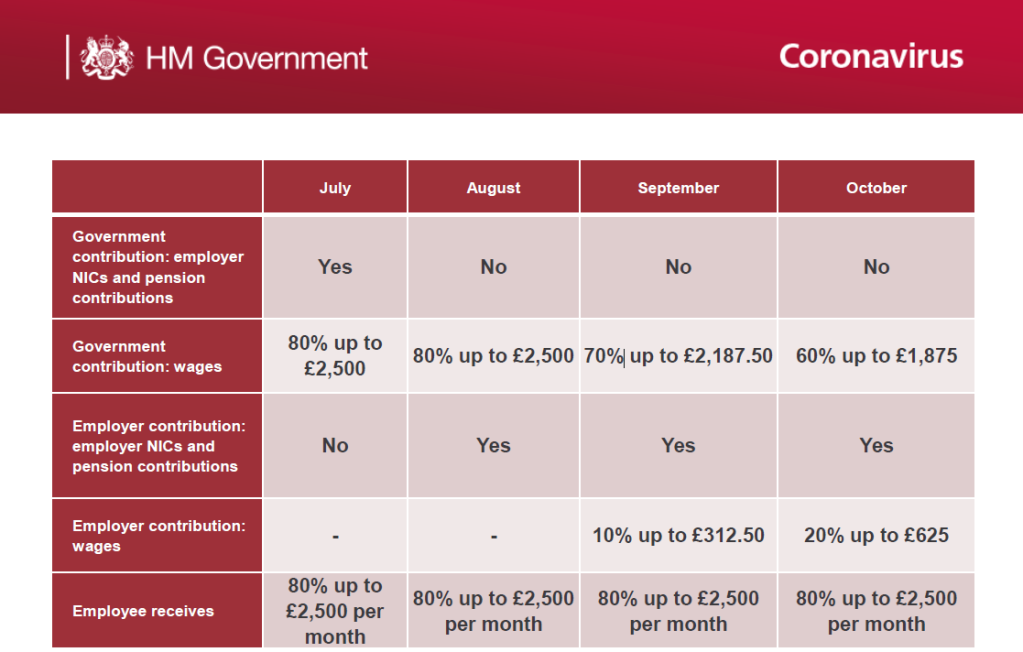
The furlough scheme will wind down flexibly and gradually until the end of October, Sunak confirms.

“Leaving the furlough scheme open forever gives people false hope that it will always be possible to return to the jobs they had before,” says the chancellor.

A jobs retention bonus will help to wind down the scheme: businesses will be paid £1,000 to retain furloughed staff. This would cost the Treasury more than £9bn if every job furloughed is protected, Sunak says.

Kickstart scheme

Sunak announces the “kickstart” job creation scheme for young people. The government will pay the wages of new young employees for six months.

There will be an initial £2bn to fund hundreds of thousands of jobs. Sunak says there will be no cap on the number of places available.

Training and jobs

Jobcentre work coach numbers will be doubled, the chancellor says.

Apprenticeships will be supported by bonuses for companies. Firms will get a payment of £2,000 for each apprentice they take on. Companies taking on apprentices aged over 25 will be given £1,500.

Green investment

Sunak says the government wants a “green recovery with concern for our environment at its heart”.

As previously announced, the government will provide £3bn for decarbonising housing and public buildings.

Vouchers worth £5,000 and up to £10,000 for poorer families will be made available out of a £2bn pot to retrofit homes with insulation, helping to cut carbon emissions.

£1bn will be allocated to make public buildings greener.

Stamp duty

The chancellor announces he will cut stamp duty to reinvigorate the housing market.

The threshold for stamp duty will increase from £125,000 to £500,000. The cut will be temporary, running until 31 March 2021, and will take effect immediately.

VAT cut for hospitality

Sunak says 2 million people work in the hospitality sector and that it has been one of the hardest hit by Covid-19, warranting further support from the government.

VAT will be cut from the current rate of 20% to 5% for the next six months on food, accommodation and attractions. The cut lasts from Wednesday 8 July until 12 January 2021.

Sunak says the move is a £4bn catalyst, benefiting more than 150,000 businesses and consumers.

Discounts on eating out

The chancellor announces an “eat out to help out discount” to encourage consumers to spend at restaurants and cafes.

Meals eaten at any participating businesses, from Mondays to Wednesdays in August, will be 50% off up to a maximum discount of £10 per head for everyone, including children.

Businesses will be able to register through a website launching on Monday. Firms can claim money back to have money in their bank accounts within five working days.

Sunak says 1.8 million people work in the industry, whose jobs can be supported. “We can all eat out to help out,” he adds.

DMS Posts, Other

Beware ‘HMRC’ phone scams – surge in calls telling victims they owe taxman £1,000s

Fraudsters are increasingly carrying out sophisticated phone scams which can involve them threatening victims with immediate arrest if they don’t pay £1,000s on the spot – and bogus calls in some cases appear to come from HMRC’s telephone number. If you receive an urgent demand to pay tax over the phone, beware.

HM Revenue & Customs revealed earlier this month that it received more than 60,000 reports of scam calls in the six months leading up to January 2019 – an increase of 360% compared to the previous six months.

And one particularly alarming scam sees fraudsters ring and tell the victim that they will be arrested for tax fraud, unless they instantly hand over payment details and pay a fee – sometimes in excess of £4,000.

Those who’ve been contacted by scammers have described the calls as “very convincing”.  MoneySavingExpert.com founder Martin Lewis tweeted about the issue after a distressed victim told him they’d lost £4,000:


Martin Lewis@MartinSLewis

IMPORTANT WARNING PLS SHARE! Beware a spate of SCAM HMRC calls eg “there’s warrant for ur arrest,” “you’re being done for fraud!” so “we need money today!” They can spoof it so it comes from HMRC’s actual number. Never pay. Call HMRC from ANOTHER phone if u want to check

.8:19 AM · Mar 14, 20193.2K4.6K people are Tweeting about this

But HMRC says it will never call you up out of the blue and tell you that you owe money, and will only ever call asking for payment on a debt that you are already aware of.

How does the ‘HMRC’ phone scam work?

This isn’t a new issue – we’ve long warned about this kind of scam call, and fraudsters pretending to be from HMRC use many different tactics to extort money from innocent people. But HMRC says it’s seen a sharp rise in bogus calls over the past six months, and one scam that’s being widely reported at the moment involves scammers ringing you and telling you that you’re suspected of tax fraud and are about to be arrested.

MoneySavers have told us that the fraudster will then ask their victim to confirm details, such as their name and postcode, before telling them how much they ‘owe’. If challenged, fraudsters then begin to give elaborate threats, for example claiming that they are dispatching police officers to arrest you within minutes, or that they will freeze your passport – neither of which, of course, they can do.

Victims are then pressured into giving their card details, which enable the scammers to take money from their account.

To make matters worse, calls often come from a number which appears similar to an HMRC one, and in some cases victims have said scammers have ‘cloned’ an HMRC number so that HMRC’s actual number appears on the screen. This is known as ‘number spoofing’ and is something Action Fraud – the UK’s national reporting centre for fraud – has previously warned about.

How to protect yourself from scam calls

HMRC has issued the following guidance to people to stop them getting caught out:

1. Recognise the signs. Genuine organisations like banks and HMRC will never contact you out of the blue to ask for your PIN, password or bank details.

2. Stay safe. Don’t give out private information, reply to text messages, download attachments or click on links in emails you weren’t expecting.

3. Take action. Forward suspicious emails and details of calls claiming to be from HMRC to phishing@hmrc.gsi.gov.uk and texts to 60599, or contact Action Fraud on 0300 123 2040 if you suffer financial loss.

If you think you’ve received a bogus HMRC call, email or text, you can check it against the examples shown in this HMRC guide. The Gov.uk website also has more info on how to avoid and report scams and recognise genuine HMRC contact, and we’ve more help in our 30+ Ways to Stop Scams guide.

If you do lose money to one of these scams, it may be possible to get money back from your bank. New rules mean that when someone has been tricked into making a payment themselves, they may be able to get cash back.

What does HMRC say?

A HMRC spokesperson said: “We will only ever call you asking for payment on a debt that you are already aware of, either having received a letter about it, or after you’ve told us you owe some tax, for example through a self-assessment return.

“We work relentlessly to close scams down and make people aware of them. HMRC has a trusted brand which can be abused by fraudsters to trick people trying to fulfil their legal obligations. We have invested heavily in protecting taxpayers against scams and anyone who suffers financial loss as a result of one should inform Action Fraud.”

DMS Posts, PAYE

Extention to the Coronavirus JRS and flexible furloughing

Coronavirus (COVID-19) Job Retention Scheme useful links

Check if you can claim through CJRS

Claim for wages through CJRS

Job retention scheme calculator

Guidance on calculating your employee wages to claim

Steps to take before calculating your claim

Work out your employee’s usual and furloughed hours

Business support finder

Get help from HMRC if you need extra support

Working safely during coronavirus (COVID-19) business webinars – find out how to make your workplace COVID-secure

The UK Government, in consultation with industry, has produced guidance for business to help ensure workplaces in England are as safe as possible during the coronavirus pandemic. 

Register to join free webinars, hosted by the Department of Business, Energy and Industrial Strategy, to find out more about how to make your workplace COVID-secure.

Check a National Insurance number using Basic PAYE Tools

NHS test and trace: how it works

Budget, DMS Posts, Tax

What’s changing for small businesses in the 2020/2021 tax year?

A new tax year is starting on April 6th, which will mean many of the changes announced in recent Budgets will come into effect. Before the 2020/2021 tax year kicks off, here’s a roundup of some of the key changes small business.

Changes to some tax and National Insurance rates and bands

Some of the rates and bands have been frozen, while others have increased. Here are the rates and bands that will come into effect on 6th April:

England, Northern Ireland and Wales

2020/212019/20
Personal allowance£12,500£12,500
Employee’s NI becomes due at£9,500£8,632
Employer’s NI becomes due at£8,788£8,632
Higher rate tax becomes due at£50,000£50,000
Class 2 NI becomes due when profits exceed£6,475£6,365
Class 2 NI per week£3.05£3.00
Class 4 NI becomes due when profits exceed£9,500£8,632

Scottish Tax Rates and Bands

The Scottish rates of income tax will change to the below on 11th May 2020.

2020/212019/20
Personal allowance£0 – £12,500£0 – £12,500
Starter rate 19%£12,501 – £14,585£12,501 – £14,549
Basic rate 20%£14,586 – £25,158£14,550 – £24,944
Intermediate rate 21%£25,159 – £43,430£24,945 – £43,430
Higher rate 41%£43,431 – £150,000£43,431 – £150,000
Top rate 46%Over £150,000Over £150,000

Employment Allowance Increased

The Employment Allowance will increase from £3,000 to £4,000 on 6th April but from this date, only businesses with an employer’s NI liability of under £100,000 a year will be eligible to claim the allowance.

National Minimum Wage / National Living Wage rates per hour increased

The following rates will all increase on 6th April:

2020/212019/20
Employees aged 25 and over: NLW£8.72£8.21
Employees aged under 18: NMW£4.55£4.35
Employees aged 18-20: NMW£6.45£6.15
Employees aged 21-24: NMW£8.20£7.70

Student Loan Income thresholds

The levels of income above which student loan repayments are due will change on 6th April as follows:

2020/212019/20
Undergraduate loan: plan 1£19,390£18,935
Undergraduate loan: plan 2£26,575£25,725
Postgraduate loan£21,000£21,000

Working from home rate for employees increased

If any of your clients operate their own limited company and claim costs for working from home, HMRC will ask them for proof of any working from home costs of over £6 (rather than £4) from 6th April 2020.

Delays and cancellations to planned changes

Corporation Tax rate holds steady

The rate at which limited companies pay Corporation Tax was originally planned to decrease from 19% to 17% on 1st April but these plans have now been cancelled. The rate of Corporation Tax will now remain at 19%.

IR35 changes delayed

Changes to the operation of IR35 legislation in the private sector that were due to take effect on 6th April 2020 have now been delayed until April 2021.